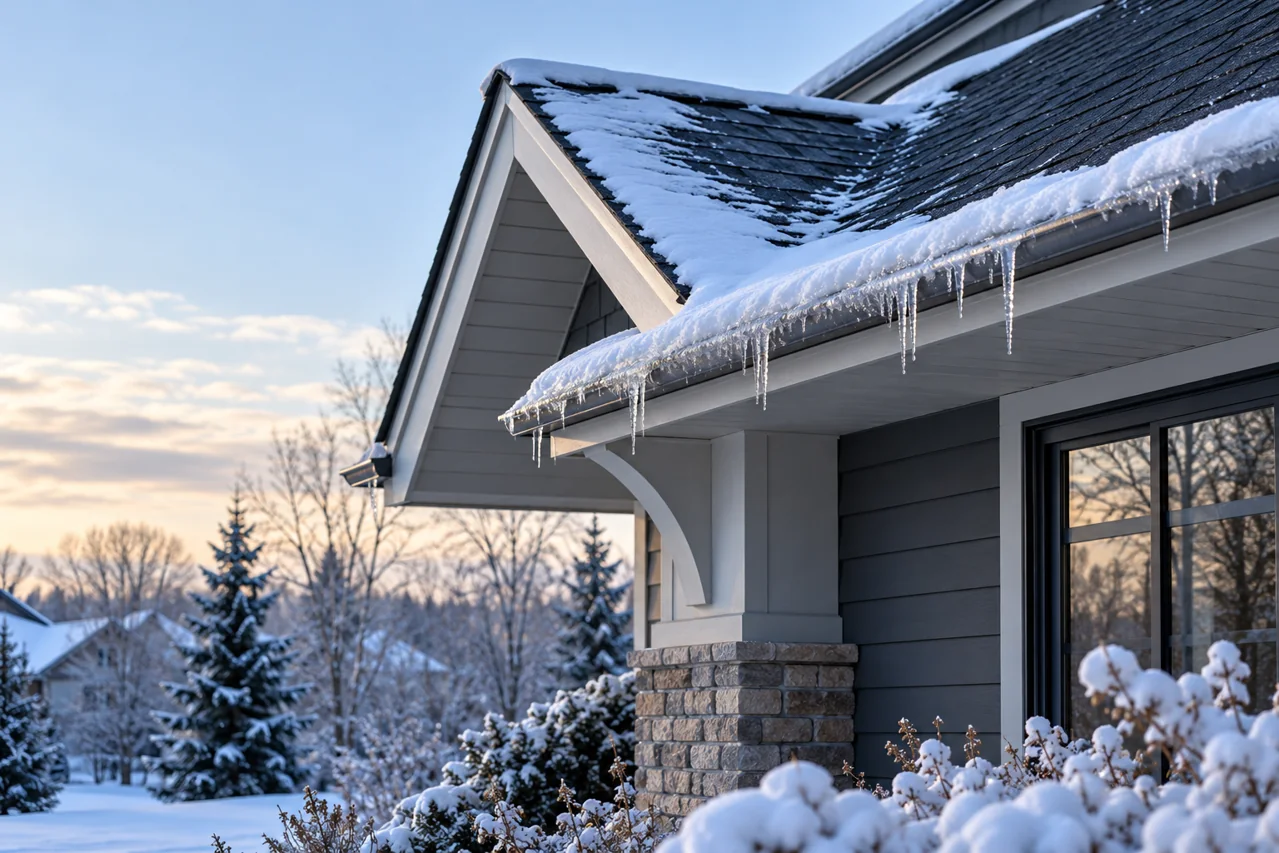
If ice keeps building at your roof edge, adding another vent may not solve the cause. The roof covering, the attic, and heat movement from the house need to be considered together. Start by documenting when and where the problem appears, then ask for an assessment of the system.
For Kalamazoo and Portage homeowners, winter roof concerns deserve a plan that looks beyond removing the visible ice.
Understand the melt-and-refreeze pattern
An ice dam forms when snow melts on a warmer portion of the roof and refreezes near a colder edge. Water can collect behind that ice and find a path into the building. The Department of Energy describes air sealing, appropriate insulation, and ventilation as parts of reducing the heat transfer behind the problem. DOE: eaves in cold climates
That does not mean every icicle identifies the same cause. Roof configuration, weather, and the home’s construction all belong in the assessment.
Three questions to ask about the attic
Where is warm air escaping?
Ask whether the inspection includes an evaluation of air leakage between the living space and attic. DOE guidance treats air sealing as an important step before adding insulation in an existing vented attic. A specialist may be needed to evaluate the building enclosure rather than only the shingles. DOE: air sealing existing attics
Is insulation doing its intended job?
Ask whether coverage and conditions are appropriate for the assembly. More material placed in the wrong location is not the same as a considered improvement. Keep the discussion tied to the actual attic rather than a generic promise of a particular insulation depth.
Is the ventilation path appropriate?
For a vented attic, ask how intake and exhaust are evaluated together and whether insulation obstructs the intended path. Some roof assemblies are designed differently, so the recommendation needs to fit the home. DOE’s attic guidance distinguishes vented and unvented designs. DOE: attic air-sealing and ventilation guide
Separate protection from root-cause correction
Roof-edge waterproofing details address one part of water protection. Air leakage and insulation address a different part of the winter problem. Ask the contractor to explain which concern each proposed item is intended to solve.
A replacement roof should not be described as a guarantee that ice dams will never occur. If the underlying heat-loss issue remains, a new exterior covering alone may leave an important part of the problem unresolved.
What you can do without getting on the roof
Photograph visible ice from a safe distance. Note the roof section, nearby room, weather conditions, and whether indoor staining appears at the same time. Keep people away from falling ice and ask a qualified professional about safe removal and investigation.
Do not chip at the roof, climb onto a snowy surface, or stand under an unstable buildup. Record the concern and get help appropriate to the hazard.
Separate the immediate leak from the recurring winter problem
When water appears during snowmelt, there are two conversations: how to address the current intrusion and how to investigate the conditions behind it. A temporary intervention is not evidence that the underlying cause has been corrected.
Ice dams can form when snow melts on a warmer roof area and refreezes at a colder edge. Water may collect behind that ice and find a path into the building. University of Minnesota Extension identifies heat loss from the home as an important contributor and discusses air sealing and insulation as long-term measures. University of Minnesota Extension: ice dams
For a Kalamazoo or Portage homeowner, the useful record is specific to the house: where ice accumulates, when water appears, and whether the same area was affected during an earlier winter. A city name alone cannot explain a roof's behavior.
Keep a winter observation checklist
- Record the date and the room where you first noticed water or staining.
- Note whether snow was present and whether the problem appeared during melting.
- Photograph visible exterior conditions only from a safe location away from falling ice.
- Save earlier repair invoices and photographs of the same area.
- Tell the contractor about any previous attic, insulation, or ventilation work.
- Ask the contractor to identify what remains uncertain after the visit.
Do not climb onto an icy roof or stand under an overhang to take a photograph. Arrange professional help for roof work. If a ceiling is bulging or water is near electrical equipment, stay clear of the affected area.
What should the follow-up proposal explain?
| Part of the response | What you should understand |
|---|---|
| Immediate work | What current condition the work addresses and its limits |
| Roofing assessment | Which roof details were examined and what was documented |
| Building assessment | Whether further attic or heat-loss investigation is recommended |
| Permanent work | Which findings justify the proposed corrections |
| Follow-up | Who to contact if the same symptom returns |
Do not assume that a new roof alone resolves the source of recurring ice dams. Equally, a winter stain is not proof of an ice dam without investigation. Ask whether the recommendation addresses observed damage, contributing conditions, or both.
Our roof ventilation guide explains questions to bring to the attic discussion. For recording water indoors, use the roof leak guide.
Turn the assessment into a coordinated plan
Ask which work belongs to a roofer and whether an insulation, ventilation, or building-performance specialist should also be involved. Clarify the sequence so one improvement does not obstruct another.
Apex can assess roofing concerns and explain the documented findings. Request a free inspection to start the conversation about your roof, and tell us about recurring winter leaks or ice when we contact you.