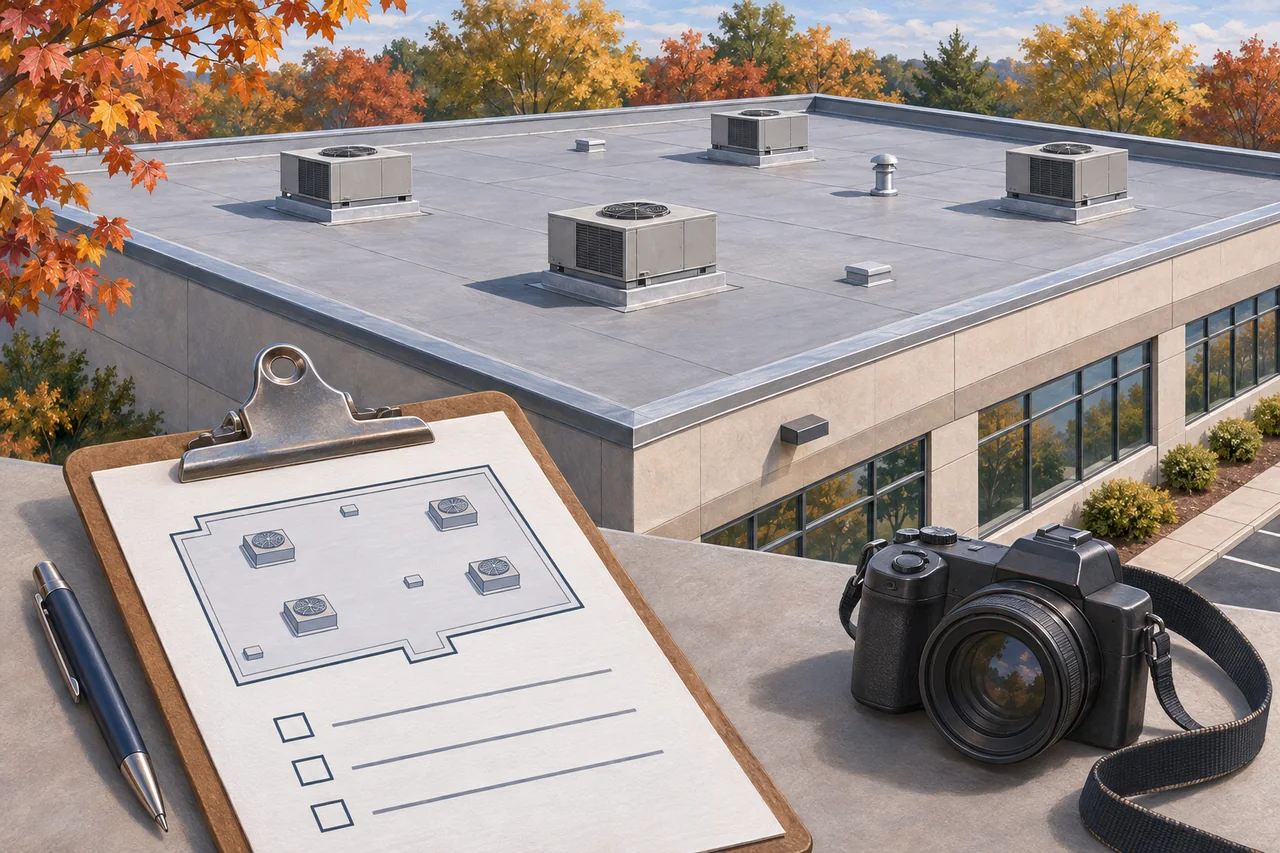
A useful commercial roof inspection report should tell you what was inspected, where each finding is located, what evidence supports it, and what action is recommended next. It should also say what could not be assessed. A collection of photographs or a single “roof needs replacement” conclusion leaves too much work for the property owner.
For a building in Kalamazoo or Portage, use the checklist below when arranging an inspection and reviewing the results. It is a practical way to request useful documentation, not a promise that every inspection includes testing, engineering, or a replacement design.
Establish the purpose and scope first
Tell the inspector what decision you need to make. Investigating a recurring leak, planning maintenance, reviewing storm concerns, and budgeting for a future replacement may call for different scopes. Provide existing roof documents and explain which areas of the building are affected.
Ask the report to identify the building, inspection date, person or company performing the inspection, and roof areas accessed. If the property has several additions, label them consistently. “Rear roof” can mean different things to a tenant, contractor, and owner; a simple plan with sections A, B, and C is easier to use.
Record the roof system and approximate installation date when supported by records. If the material, age, or assembly is uncertain, the report should say so. An estimate should not quietly become a confirmed fact in next year's budget.
Connect each finding to a location and photograph
Request an overview image for context and a closer image for the specific condition. Give the finding a reference number and put that number on a roof sketch or location list. This lets you connect the report, repair proposal, and completion record later.
GAF's commercial maintenance guidance identifies debris, water, clogged drains, loose flashing, and wind-related concerns as subjects for professional inspection. Those categories help organize a review, but they do not establish what is wrong with your particular building. GAF: Commercial roof asset management and maintenance
A practical report can group observations this way:
| Area | Useful information to request |
|---|---|
| Roof surface | Location and photographs of visible damage or other concerns |
| Seams and transitions | Specific detail observed and recommended follow-up |
| Edges and parapets | Identified condition of accessible edge and flashing details |
| Drains and outlets | Debris, visible water, and any limits on drainage assessment |
| Rooftop equipment | Findings around curbs and penetrations, with equipment identified |
| Interior concerns | Room location, reported leak history, and related photographs |
For drainage concerns, ask when it last rained and when the observation was made, if known. A photograph of water without timing or location gives you less useful information than a dated, mapped observation. Do not turn one photograph into an unsupported conclusion about the whole roof.
Separate observations, explanations, and unknowns
A strong report makes clear whether a statement is something the inspector saw, an explanation they suspect, or a conclusion supported by additional investigation. Ask what evidence connects an interior leak to the proposed roof repair.
The report should describe access restrictions and other limits: an area not entered, a surface obscured by snow or equipment, or an interior room unavailable during the visit. Ask whether the inspection was visual only and whether any separate testing was included. Do not read “no visible issue observed” as a finding about every concealed layer.
If additional investigation is recommended, request its purpose before authorizing it. What question would it answer? Which area would it cover? How would the result change the repair or replacement recommendation? A useful next step resolves an uncertainty relevant to your decision.
Turn the findings into an action list
Ask the inspector to distinguish immediate concerns, recommended repairs, routine maintenance, and items to monitor. Each action should refer back to a finding and explain the proposed next step. Request a timeframe appropriate to the condition, rather than assuming every item has the same urgency.
Hypothetical example, not an Apex project: a report lists debris near a drain as finding D1 and a separate flashing concern near rooftop unit H2 as finding F2. The manager can then ask for a scope that addresses D1 and F2 separately, identifies any investigation still needed, and states how completion will be documented. “Service the roof” is much harder to compare with the report or invoice.
Before approving work, clarify:
- Which finding numbers are included in the proposed scope?
- What remains excluded or uncertain?
- Is the recommended work maintenance, a repair, or further investigation?
- Who needs to coordinate access, tenants, or rooftop equipment service?
- What photographs or other records will close each item?
- When should unresolved items be reviewed again?
The report and repair proposal can be separate documents. What matters is that you can trace the recommendation through to the work you approve.
Keep the report with the roof's existing records
Carlisle's owner guidance emphasizes retaining warranty documents, maintenance inspections, rooftop traffic and service logs, invoices, and photographic documentation. It also identifies roof edges, membrane areas, and penetrations as inspection priorities for its systems. Use the actual manufacturer's guidance for the roof you own. Carlisle: Owner maintenance guidance and records
Gather the existing warranty or guarantee document before ordering repairs or alterations. Ask whether the proposed work requires coordination with its issuer or an authorized contractor. A report does not itself establish coverage, and this guide does not imply that Apex holds any particular manufacturer authorization.
Keep a simple folder for the original report, approved scope, completion record, invoice, and open-item list. At the next inspection, provide the prior report and ask which findings are resolved, unchanged, or different. This gives the next visit a useful starting point without replacing a fresh assessment.
Request documentation that supports your next decision
For a commercial property in Kalamazoo or Portage, explain your concern and the decision you need help making when contacting Apex. Share available roof records, known leak locations, access arrangements, and any tenant or equipment-service constraints. Ask what inspection and reporting scope is appropriate for that building.
Explore Apex commercial roofing services or request a roofing quote. A clear starting brief helps connect the inspection findings to a practical proposal.